
Category definition
What is a security signal fabric?
Detection is broken because it starts too late. The signal fabric fixes timing by extracting intelligence directly from live network telemetry — before log pipelines introduce delay.
The problem
Detection happens after the fact
Most security stacks rely on logs — records of what already happened. By the time activity is collected, normalized, stored, and analyzed, attackers have already moved. This isn't a tool problem. It's an architectural gap.
Logs are post-event artifacts. They tell you what happened, not what's happening. The faster attacks get, the wider this gap becomes.
Higher fidelity sooner
Signal Fabric reaches near-complete sighs signal fidelity within the first second. Traditinal pipelines never close the gap.

signal Fabric
A new layer in the security stack
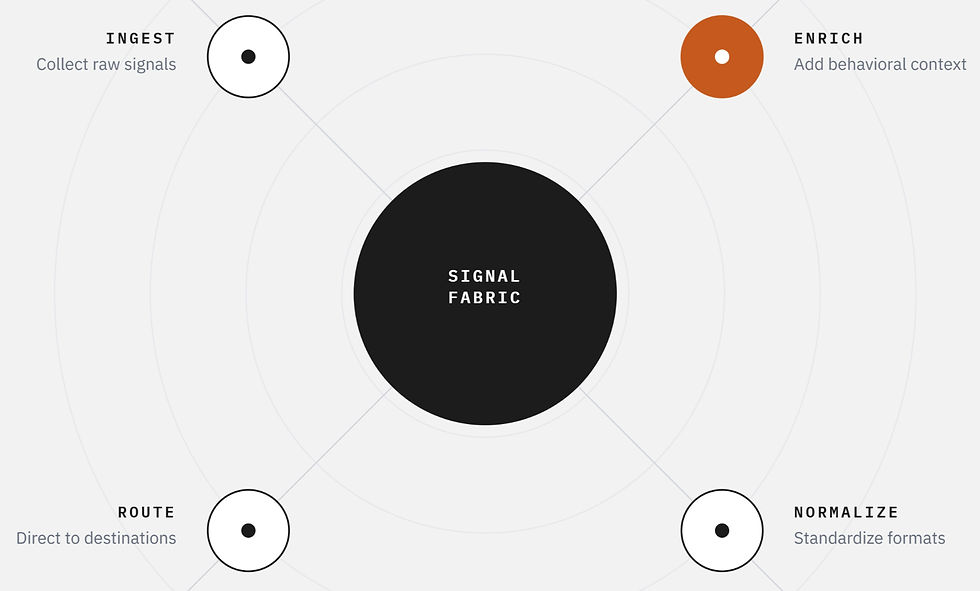
A signal fabric extracts structured, decision-grade signals directly from live network telemetry. It sits upstream of your SIEM, XDR, NDR, and SOAR — improving what they can see and act on.
Without the signal fabric layer
Detection runs on delayed logs. Correlation happens after ingestion. Alert quality depends on input quality — and inputs are late, fragmented, and noisy.
With the signal fabric layer
Structured signals arrive before log pipelines. Detection systems operate on higher-fidelity inputs. Earlier awareness of meaningful events. Existing tools get better.
Where it sits
The signal fabric in the security stack

Frequently asked
Why does log-based detection miss modern attacks?:
Log-based detection misses modern attacks because it operates on delayed, post-processed data. By the time activity is collected, normalized, and analyzed, attackers have already moved laterally or executed payloads. This is why modern architectures are shifting toward extracting signals directly from live network telemetry.
What is the difference between a signal layer and NDR?
NDR detects threats within network traffic. A signal layer operates upstream — extracting and structuring signals before they reach NDR, SIEM, or any other detection system. It improves what those tools can see, rather than replacing them.
What is real-time signal intelligence?:
Real-time signal intelligence is the extraction of structured, decision-grade signals from live network telemetry as it flows — not after it's been logged, stored, and processed. It represents a shift from reactive detection to in-flight visibility.